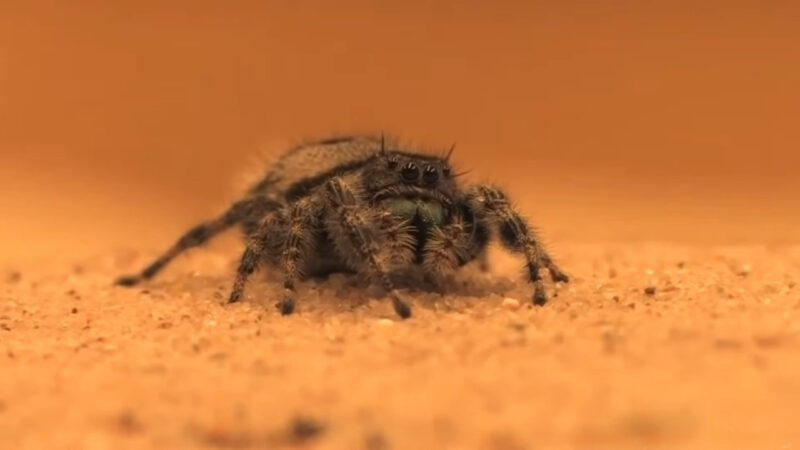

Most spiders do their best to stay unnoticed. Jumping spiders are different. They sit in the open, turn to look directly at you, and sometimes seem to follow your movement with their large front-facing eyes.
Iowa has a surprisingly varied collection of them. The Insects of Iowa database lists dozens of jumping spider species recorded in the state, including bold jumpers, bronze jumpers, white-jawed jumping spiders, peppered jumpers and several brightly colored members of the Phidippus and Habronattus groups.
They are also among the easiest spiders to watch without disturbing. Many spend daylight hours hunting on fences, siding, flowers, tree trunks, and garden plants rather than sitting in webs waiting for prey.
Why Do Jumping Spiders Look So Different?
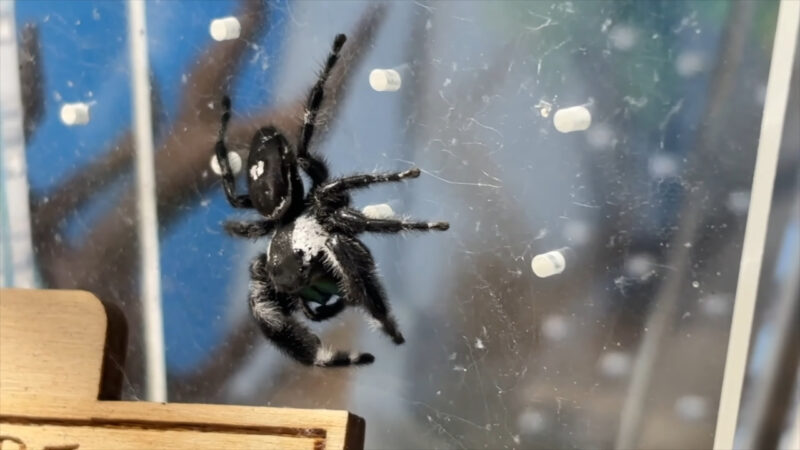
Jumping spiders belong to the family Salticidae. Their most obvious feature is the arrangement of eight eyes, especially the large pair facing forward.
Those eyes are not decorative. Jumping spiders rely heavily on vision to hunt. Instead of building a prey-catching web, they watch insects, judge distance, and launch themselves forward when they get close enough.
The result is a spider that behaves more like a tiny stalking predator than the web-builders most people picture.
They still produce silk, but they use it differently. A jumping spider can attach a silk safety line before moving across a surface or making a jump. Females also use silk to build protected retreats for eggs.
Bold Jumping Spider
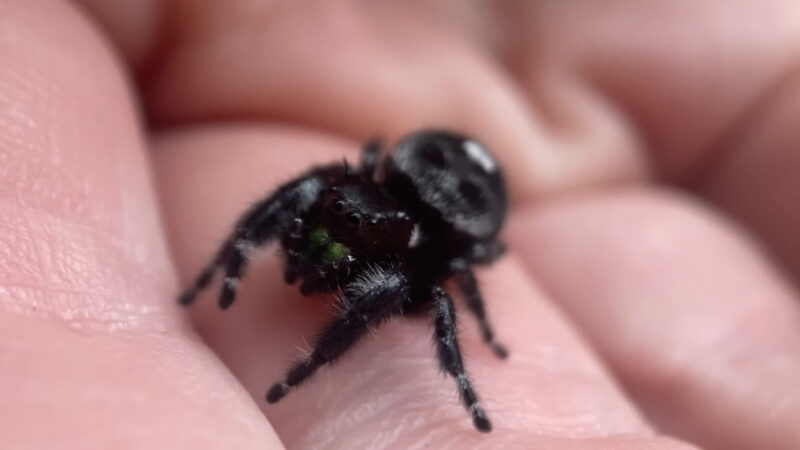
The bold jumping spider, Phidippus audax, is one of the easiest Iowa species to recognize and one of the best examples of why people become fascinated with the group.
Adults are predominantly black with pale spots on the abdomen. Their mouthparts can shine metallic green or blue depending on the angle of the light.
Records in BugGuide confirm the species in Iowa across multiple months of the year, and Iowa observations include individuals photographed in places such as Muscatine, Davenport and Pella.
Bold jumpers turn up around houses, gardens, fences and vegetation. They are relatively large for jumping spiders, which makes their behavior easier to watch without a magnifying glass.
One may notice you before you notice it. Move a finger slowly nearby, and the spider may rotate to keep you in view rather than immediately running away.
Bronze Jumper
View this post on Instagram
The bronze jumper, Eris militaris, is another species recorded in Iowa.
Its coloring is less dramatic than the deep black of a bold jumper, but the body has a warm bronze-brown appearance that blends well with bark, wooden fences, and dried vegetation.
Bronze jumpers hunt during the day and use the same stop-and-watch style common across the family. A spider may sit still for several seconds, move a short distance, stop again, and then suddenly rush toward a small fly or other insect.
White-Jawed Jumping Spider
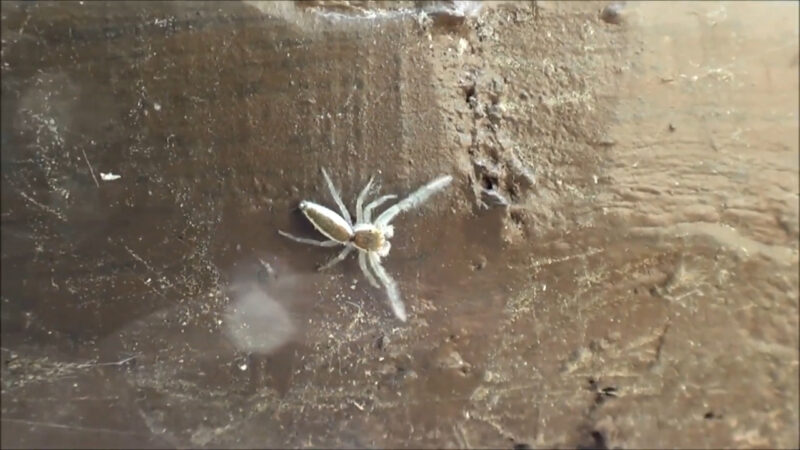
Hentzia mitrata, commonly called the white-jawed jumping spider, is another species listed in Iowa records.
It is more slender than a bold jumper and usually has lighter coloring. The pale mouth area helps give the species its common name.
Look for it on foliage and low vegetation. Smaller jumping spiders are easy to miss until you deliberately begin checking individual leaves instead of scanning an entire plant.
Golden Jumping Spider
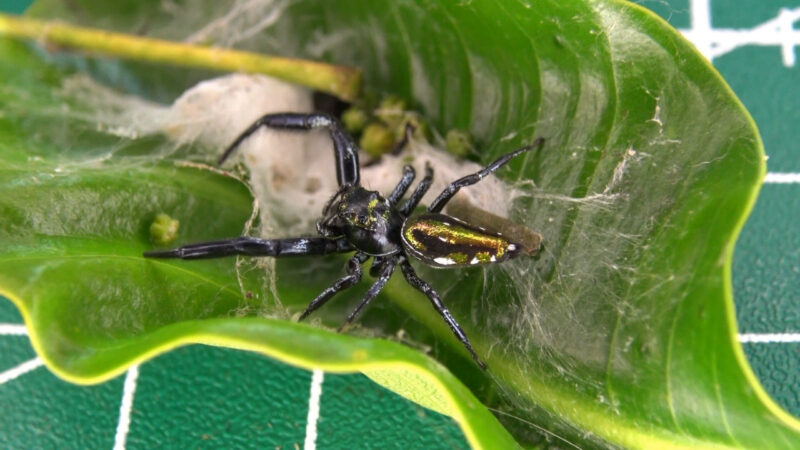
The golden jumping spider, Paraphidippus aurantius, is one of the more colorful members of Iowa’s Salticidae list.
Adults can show metallic green, bronze, and orange tones. Color varies between individuals and sexes, so identification should rely on more than one feature.
Like other jumping spiders, it searches vegetation for insects rather than depending on a large capture web.
Peppered Jumper
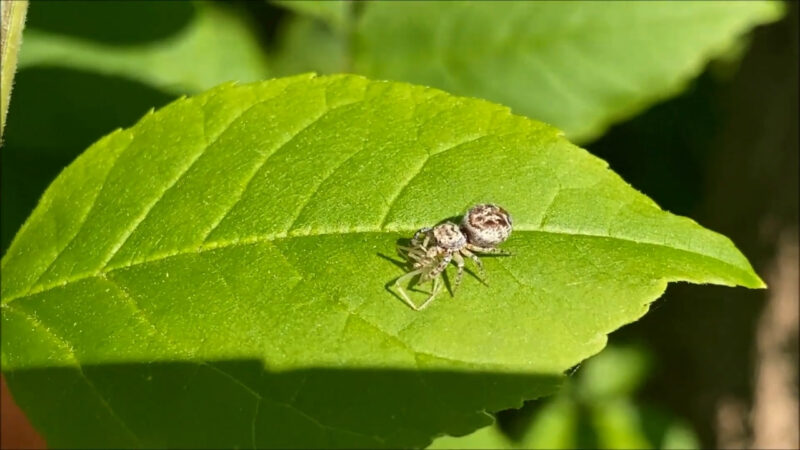
The peppered jumper, Pelegrina galathea, is considerably smaller than the big Phidippus spiders.
Its body carries a mixture of gray, brown, white, and darker markings that work particularly well as camouflage against bark and dried plant material.
Small jumpers such as this are one reason a quick glance at a backyard can badly underestimate the number of spiders living there. Many are only a few millimeters long and disappear visually against textured surfaces.
Zebra Jumping Spider
@thephidbizz this pretty female zebra jumper’s coloration was super bold and golden! she was super friendly too. how special ✨⭐️ #zebra #zebrajumper #salticusscenicus #spider #jumpingspider #jumpingspiders – – #petlover #pet #petsoftiktok #petlife #wildlife #nature #naturelovers #wild #illinois #stopthesmoosh #bug #arachnid #insect #bugs #insects #arachnids #spiders #il ♬ originalljud – Skitok⛷️
The zebra jumping spider, Salticus scenicus, gets its name from the black-and-white banding across its body.
It has a strong association with walls, fences, rocks, and other vertical surfaces, making it one of the species people can encounter around buildings.
A sunny exterior wall is worth checking during warm weather. Flies and other small insects are attracted to the same surfaces, giving the spiders a steady hunting ground.
Some Iowa Jumping Spiders Are Tiny
Not every member of the family looks like the chunky spiders people share in close-up photographs.
Iowa records include much smaller genera such as Talavera, Naphrys, Tutelina and Sassacus. Some are small enough to resemble moving specks until viewed closely.
The state spider database currently contains records from 257 spider species across Iowa, with jumping spiders making up a substantial and varied part of that list.
Anyone already spending time on Iowa trails has a good chance of walking past them.
Our guide to backpacking in Iowa covers woodland and prairie environments where small arthropods become much easier to notice once you begin paying attention to logs, leaves, and sunny trail edges.
They Really Do Jump
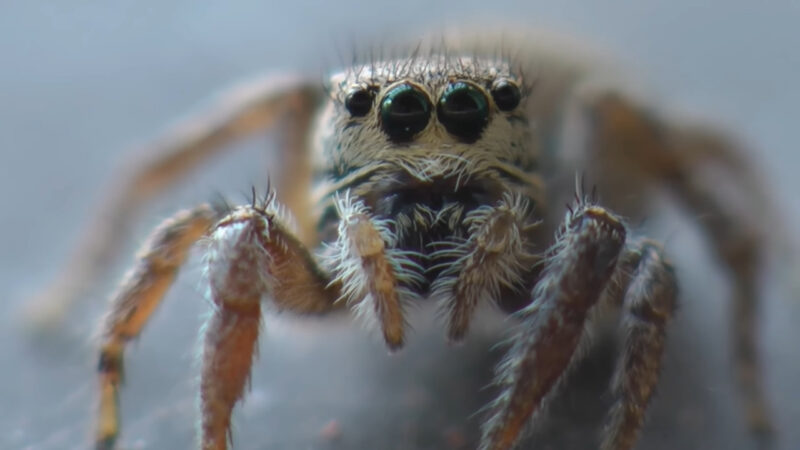
The name is accurate, although the spiders are not bouncing around constantly.
Jumping is mainly used during hunting, escaping danger, and crossing gaps. Their legs generate rapid acceleration that allows them to cover several body lengths in a fraction of a second.
Before a larger jump, the spider typically attaches silk to the surface. If it misses its landing, the silk provides a line back to safety.
Watching one hunt makes the sequence easier to see. The spider notices prey, turns toward it, approaches in short bursts, and stops repeatedly to reassess distance. The final leap happens only when it is close enough.
Jumping Spiders Have Excellent Eyesight
The two large central eyes provide detailed forward vision. Additional eyes around the head expand the spider’s field of view and help detect movement from other directions.
Researchers study jumping spider vision because such a small animal manages a surprisingly complicated visual system inside a tiny head.
Good eyesight also explains the behavior people interpret as curiosity. A jumping spider facing a person is actually collecting visual information and deciding whether the large moving object represents danger.
Male Jumping Spiders Dance for Females
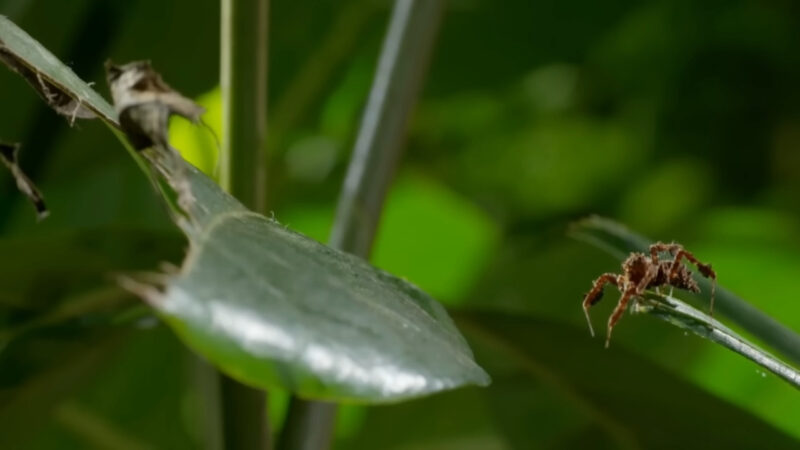
Some of the most elaborate behavior appears during courtship.
Males use combinations of leg movements, body vibrations, and visual displays to attract females. Species in the genus Habronattus are especially well known for complex courtship displays, and several Habronattus species are recorded in Iowa.
The details vary by species. A male may raise and wave its front legs, shift its body from side to side, or display patches of color that are much easier for another spider to appreciate than for a person standing several feet away.
Those displays also come with risk. The female is still a predator, and an unsuccessful approach can put the male dangerously close to a much larger spider.
Are Jumping Spiders Dangerous?
Jumping spiders are predators capable of biting prey, but they are not spiders Iowa residents need to treat as a serious household threat.
They normally rely on escape rather than confrontation when dealing with people. Bites are uncommon and generally associated with a spider being trapped against skin or deliberately handled.
The Iowa spiders that receive more attention from a medical-risk perspective are species such as black widows and brown recluses.
A jumping spider sitting on a windowsill or fence is far more interested in hunting flies than approaching anyone nearby.
They Can Be Useful Around Homes and Gardens
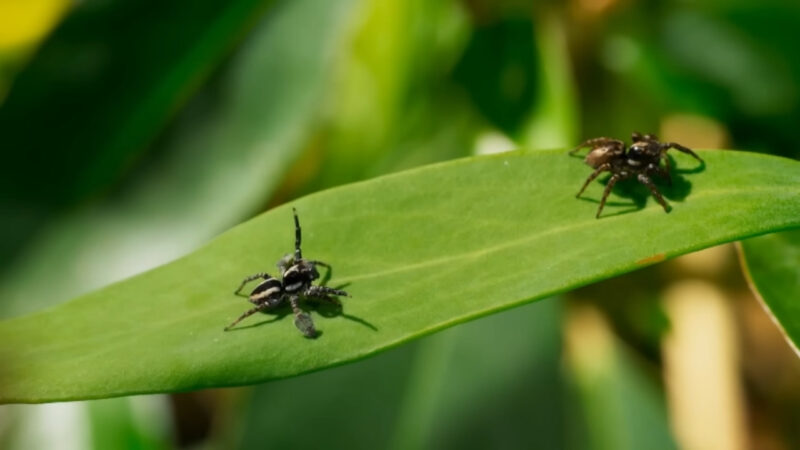
Jumping spiders eat small insects and other arthropods, including flies, mosquitoes, moths, and plant-feeding insects that fall within the size range they can overpower.
They do not provide pest control on the scale of a professional treatment, but killing every jumping spider around a garden removes a predator that is already hunting there for free.
Gardens with flowers are particularly productive places to watch them because flowers attract both pollinators and smaller insects. A jumping spider can wait near a bloom and take advantage of that traffic.
Where to Look for Jumping Spiders in Iowa
You do not need a special trip. Start around your own home.
Warm, dry daylight hours are generally better than searching after dark because jumping spiders depend so heavily on vision. State parks provide plenty of additional habitat. Viking Lake State Park, for example, combines woodland, prairie vegetation and open sunny areas where small wildlife is easy to watch along the trails. Jumping spiders are common enough that finding one is less about traveling to the right place and more about changing how you look at an ordinary place. Check a fence one section at a time. Look closely at a flower before walking past it. Watch the tiny dark shape moving across a leaf instead of assuming it is an ant. Once you recognize the large forward-facing eyes and stop-and-go hunting style, jumping spiders become surprisingly easy to pick out. Bold jumpers are the obvious starting point, but Iowa records show that the family is far more varied than one familiar black spider with shiny green mouthparts.
The Best Way to See One Is to Slow Down