


Iowa ecommerce in 2026 gives online sellers a market that looks smaller than coastal states, yet still carries serious buying power.
Estimated online retail sales in Iowa sit around $10.4 billion, with strong digital access, a population near 3.24 million, and early 2026 retail momentum in categories like apparel, hobby products, sporting goods, specialty retail, and general merchandise.
For sellers, the bigger point is simple: Iowa buyers may be slightly more store-oriented than the national average, so clear delivery times, easy returns, local trust signals, and clean pricing can shape the sale.
For Amazon sellers, marketplace brands, and direct-to-consumer businesses, Iowa also matters from an operations angle.
A good prep center, like Dollan Prep Center, can help sellers manage inventory, inspection, labeling, bundling, returns, and FBA shipment prep before products reach customers or fulfillment networks.
That becomes especially useful when sellers want to serve Midwest buyers faster, keep stock organized, and avoid fulfillment mistakes while tracking Iowa sales tax rules, same as property taxes, marketplace obligations, and category demand in 2026.
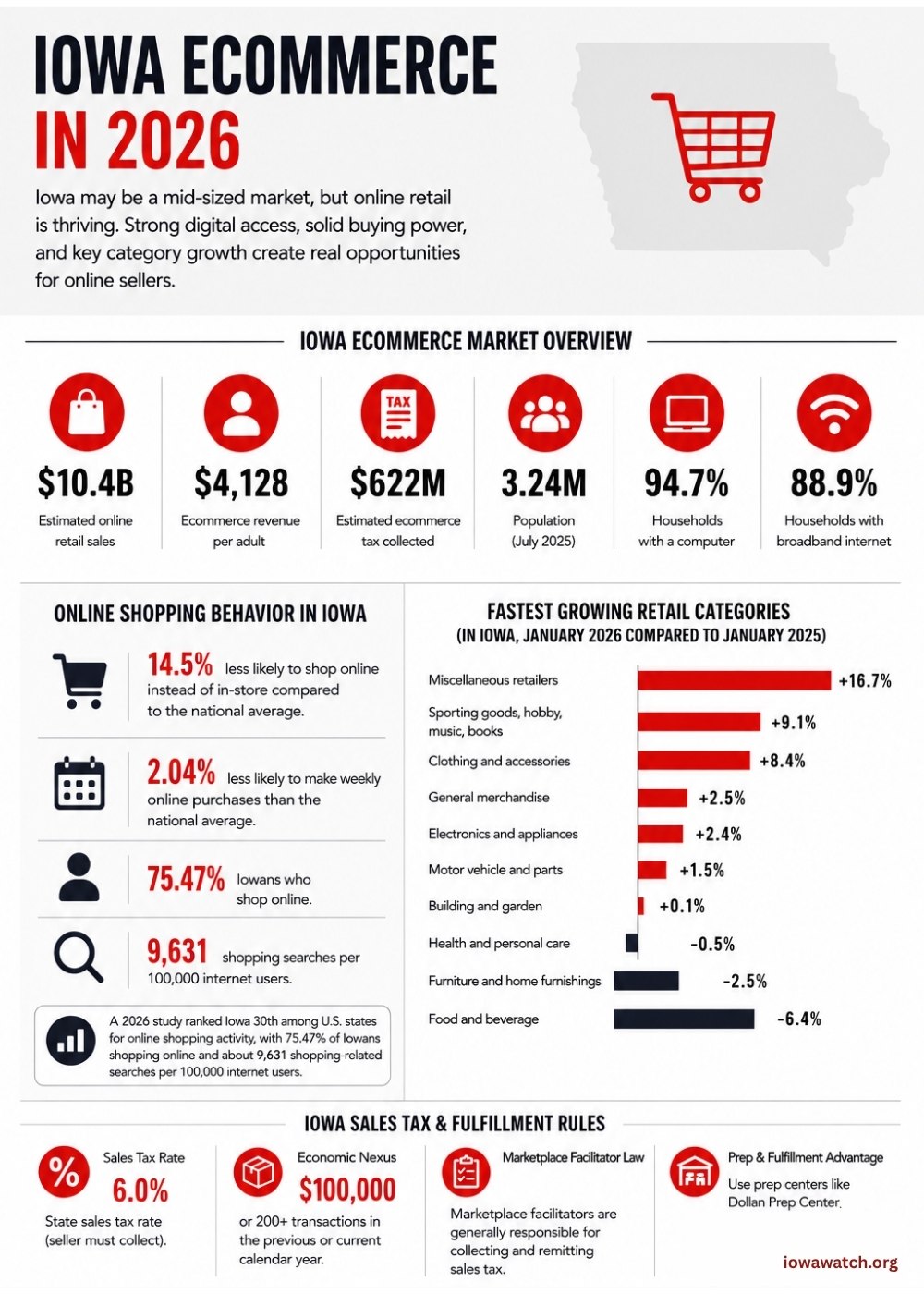
Iowa Ecommerce Market Size In 2026
Iowa should not be treated like a small, low-value ecommerce market. The state has an estimated $10.4 billion in online retail sales, equal to about $4,128 in ecommerce revenue per adult.
That figure puts Iowa below major population states, yet the spending base remains large enough for Amazon sellers, Shopify brands, marketplace resellers, and niche direct-to-consumer stores to build serious revenue from Iowa buyers.
Capital One Shopping also estimates that Iowa online retailers collect about $622 million in ecommerce-related retail tax, or $247.70 per capita, which shows that online buying already carries meaningful weight in the state retail economy.
| Iowa Ecommerce Indicator | Latest Figure | What Online Sellers Should Take From It |
| Estimated online retail sales | $10.4 billion | Iowa has enough ecommerce demand to support serious marketplace and DTC selling |
| Ecommerce revenue per adult | $4,128 | Buyer value is strong, even without coastal-state scale |
| Online shopping tendency | 14.5% less likely to shop online than in-store | Sellers need clear pricing, trust signals, delivery details, and easy returns |
| Weekly online purchase frequency | 2.04% below the U.S. average | Email, retargeting, bundles, and repeat-purchase offers matter |
| Estimated ecommerce tax collected | $622 million | Iowa sales tax compliance should be part of seller planning |
| Ecommerce tax per capita | $247.70 | Online selling already produces a meaningful tax footprint in Iowa |
The market has another advantage: Iowa has the digital access needed for online retail to keep growing. The U.S. Census Bureau estimates Iowa at 3.24 million people in July 2025, with 1.32 million households, 94.7% of households with a computer, and 88.9% with a broadband internet subscription.
Official national ecommerce data supports the wider trend. U.S. ecommerce sales reached $1.2337 trillion in 2025, up 5.4% from 2024, while total retail sales increased 3.5%. Ecommerce also reached 16.4% of total U.S. retail sales in 2025, up from 16.1% in 2024.
Online Shopping Behavior In Iowa

Iowa buyers are online, but the state still leans more store-oriented than the national average.
Capital One Shopping estimates that Iowa consumers are 14.5% less likely to shop online instead of in-store, and 2.04% less likely than the average American to make weekly online purchases.
For sellers, that points to a buyer who may compare harder, wait longer, and need clearer reasons to place the order online rather than buy locally.
| Iowa Online Shopping Signal | Latest Figure | Seller Insight |
| Online retail sales estimate | $10.4 billion | Demand exists, but sellers still need strong trust signals |
| Ecommerce revenue per adult | $4,128 | Buyer value is solid for a mid-sized state |
| Likelihood to shop online vs. in-store | 14.5% below average | Product pages need clear pricing, delivery, returns, and reviews |
| Weekly online purchase rate | 2.04% below U.S. average | Retention campaigns and repeat-purchase offers matter |
| Iowans who shop online | 75.47% | Most residents buy online, even with a more selective pattern |
| Shopping searches per 100,000 internet users | 9,631 | Search demand exists, but sellers need category-specific SEO and marketplace visibility |
The same report described Iowa online shopping as more needs-based than impulse-led, which fits the wider signal: sellers should not treat Iowa as a pure browsing market.
Fastest Growing Retail Categories For Iowa Sellers

Iowa category demand in early 2026 is uneven. The strongest official state-level retail signals come from the Monthly State Retail Sales series on FRED, which uses U.S. Census Bureau experimental data.
For Iowa, the latest available month in the series is January 2026, updated April 30, 2026.
| Category | Growth Signal |
| Miscellaneous retailers | +16.7% ████████████████ |
| Sporting goods, hobby, music, books | +9.1% █████████ |
| Clothing and accessories | +8.4% ████████ |
| General merchandise | +2.5% ██ |
| Electronics and appliances | +2.4% ██ |
| Motor vehicle and parts | +1.5% █ |
| Building and garden | +0.1% ▏ |
| Health and personal care | -0.5% ▼ |
| Furniture and home furnishings | -2.5% ▼▼ |
| Food and beverage | -6.4% ▼▼▼▼▼▼ |
Hobby and outdoor-related products also deserve attention. Iowa sales for sporting goods, hobby, musical instrument, and book stores rose 9.1% year over year in January 2026.
Iowa Sales Tax And Fulfillment Rules For Online Sellers

Iowa ecommerce growth also brings a compliance question that sellers cannot leave for later.
The state sales and use tax rate is 6%, and many local jurisdictions add a 1% local option sales tax on most taxable sales.
| Iowa Seller Rule | Current Iowa Guidance | What Online Sellers Should Do |
| State sales tax rate | 6% | Build tax settings around Iowa state sales tax first |
| Local option sales tax | 1% in many jurisdictions | Check local tax by buyer location before relying on a flat rate |
| Remote seller threshold | $100,000 in gross revenue from Iowa sales | Track Iowa sales by calendar year before campaigns scale |
| Marketplace facilitator threshold | $100,000 or more in Iowa sales | Confirm whether the marketplace collects tax on Iowa orders |
| Marketplace-only sellers | Permit may be unnecessary when the marketplace collects Iowa tax | Keep marketplace tax reports for records |
| Mixed-channel sellers | Marketplace and direct website sales count together for threshold testing | Separate tax collection duties for website sales from marketplace sales |
Remote sellers must collect Iowa sales tax only after reaching $100,000 or more in gross revenue from Iowa sales, and that threshold includes all Iowa revenue, including exempt sales, wholesale sales, resale sales, and marketplace sales where the marketplace already collected tax.
Marketplace rules matter because Amazon, Walmart Marketplace, eBay, Etsy, and similar platforms may collect Iowa sales tax on marketplace orders.
The bigger risk appears when sellers use both marketplaces and their own websites.
A remote seller with both marketplace and non-marketplace Iowa sales must add total gross revenue from both channels to decide whether collection duties apply on direct sales.
Iowa also provides a Tax Mapper that lets businesses search or browse state and local option sales tax by address or location. That tool matters because local option sales tax can vary by jurisdiction, and online sellers need location-level accuracy when tax software, checkout settings, or invoices are configured.
Conclusion
The state has an estimated $10.4 billion online retail market, strong broadband coverage, and early 2026 retail momentum in specialty retail, hobby products, sporting goods, apparel, accessories, and general merchandise.
The opportunity is not automatic. Iowa buyers still lean more store-oriented than the national average, which means sellers need clean product pages, clear delivery dates, simple returns, accurate inventory, strong reviews, and reliable fulfillment.
A weak listing or late shipment can lose the buyer to a local store or a better marketplace offer.